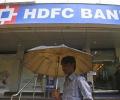
Shares of HDFC Bank will witness massive inflows totalling $600 million from passive trackers this week, predict analysts. This influx is attributed to the rebalancing activities in the S&B BSE Sensex and the Financial Times Stock Exchange (FTSE) indices. The Sensex is set for its quarterly rebalancing act on September 15 (date of adjustment), resulting in inflows of $102 million (approximately Rs 850 crore).

The OCCRP report alleges that at one point, EIFF and EMRF held free-floating shares ranging from 8 per cent to nearly 14 per cent in the four Adani Group companies.

The proposal to merge the Gujarat International Finance Tec-City (GIFT City) units of the National Stock Exchange (NSE) and BSE has reached an advanced stage, and both bourses could file an application before the National Company Law Tribunal as early as this month, according to a top regulatory official. Sources indicate that the merger proposal has received approval from their respective boards. Both the NSE and BSE are arch rivals when it comes to onshore trading.

Polycab India, Power Finance Corporation, Shriram Finance, and Union Bank of India appear poised to transition from the mid-cap to the large-cap category within the domestic mutual fund industry. Their market capitalisation (m-cap) now ranks among the top 100, which is the threshold for the large-cap universe defined by the Securities and Exchange Board of India.

The International Financial Services Centre Authority (IFSCA) plans to operationalise the framework for direct listing of companies at International Financial Services Centre (IFSC) exchanges by the end of the year, said Chairperson K Rajaraman. He added that the amendments would be notified within three months. Further, the GIFT City regulator is also considering the launch of separate payments system regulations - similar to that of the real time gross settlement (RTGS) for banking within a few months.

The BSE has decided to move the expiry day of Bankex derivatives contracts from Friday to Monday, effective October 16, the bourse said on Wednesday. "New contracts of S&P BSE Bankex with Monday expiry will be generated on October 13, 2023, and will be available for trading with effect from October 16, 2023," the BSE said, citing the decision was based on the market feedback. The expiry of Sensex derivatives contracts will continue to be on Friday.
The International Financial Services Centres Authority (IFSCA) has proposed key exemptions to the current listing framework and measures for setting up holding companies (holdcos) and special purpose acquisition companies (SPACs) to encourage domestic startups list at GIFT City, the country's only international financial services centre (IFSC). Under the current framework, to be eligible to list on IFSC exchanges, an issuing company should have operating revenue of at least $20 million in the preceding financial year and average pre-tax profits of at least $1 million during the preceding three financial years. An expert committee has noted these conditions have acted as hurdles to listing new-age companies, and they need a relook.

In an effort to attract investors to the Social Stock Exchange (SSE), the bourses have reached out to the Securities and Exchange Board of India (Sebi) and the government with the industry's demand for additional benefits on contributions made towards social enterprises through the platform. SSE is a regulated platform to facilitate organisations working towards social causes to raise funds and have access to higher capital through the bourses. The platform is aimed at becoming a meeting ground for donors and social enterprises.

A new regulation concerning the disclosure of family arrangements by listed companies is exacerbating rifts between feuding shareholders. The latest example is Bengaluru-based TD Power Systems (TDPS), currently enmeshed in a legal dispute before the Karnataka high court over ownership of its 16 per cent equity. Vijay Kirloskar, who is asserting a claim over the 16 per cent stake held by Mohib Khericha (chairperson of TDPS) and Nikhil Kumar (managing director of TDPS and nephew of Kirloskar), has sent a letter to the market regulator, Securities and Exchange Board of India (Sebi), and stock exchanges. He accuses TDPS of insufficient disclosure concerning shareholder agreements.

The shift to a shorter T+3 settlement cycle for initial public offerings (IPOs) will be a big test of the domestic market structure, requiring players in the ecosystem to work harder to meet the squeezed timelines, according to industry insiders. The Securities and Exchange Board of India (Sebi), has announced that the transition to the T+3 cycle will be voluntary starting next month and mandatory from December 1. The new mechanism will necessitate quicker confirmations from banks and speedy verification of permanent account numbers (PANs) for all applicants.

Companies, which missed out on listing earlier, are giving it another shot but with significantly-reduced issue sizes. In the recent past, companies such as TVS Supply Chain Solutions, Suraj Estate Developers, and ESAF Small Finance Bank have re-filed their draft red herring prospectuses (DRHPs) with the Securities and Exchange Board of India (Sebi). This came after they slashed their issue sizes by 20-60 per cent.
BSE's fresh shot at cracking the derivatives market is off to a promising start. However, Asia's oldest bourse is facing resistance from brokerages with nearly 10 large brokers yet to offer the relaunched Sensex and Bankex derivatives on their platforms. Many brokers maintain that they are working on the back end to enable BSE derivatives on their apps and websites. Some said while volumes are picking up, they are still miniscule compared to bigger rival NSE, which is the most-preferred venue for derivatives trading. Only a few brokers responded to formal queries sent by Business Standard on the issue of allowing BSE derivatives on their platform.

Jio Financial Services, a unit of Mukesh Ambani's Reliance Industries (RIL), got valued at Rs 1.66 trillion ($20 billion) following an hour-long special trading session conducted by stock exchanges on Thursday. Shares of RIL's unit got priced at Rs 261.85 apiece - higher than analysts' expectations of Rs 134-224 per share. The price was arrived at after calculating the difference between RIL's Wednesday (July 19) close of Rs 2,840 and Rs 2,580, the price discovered during the first-of-its-kind pre-trade session.

The Securities and Exchange Board of India (Sebi) is in the process of issuing a standard operating procedure (SOP) for designated depository participants (DDPs) regarding disclosures and onboarding of foreign portfolio investors (FPIs), according to a regulatory document seen by Business Standard. DDPs act as a link between the markets regulator and overseas investors. The SOP, framed in consultation with the industry, aims to bring consistency across all players and avoid any form of regulatory arbitrage.

Following a more than 15 per cent surge in the National Stock Exchange (NSE) Nifty 50 from this year's lows, the spread between the 10-year government security (G-sec) and the Nifty earnings has approached the danger zone of 2 percentage points (ppt). At present, the G-sec yield is roughly 7.09 per cent, while the Nifty earnings are 5.12 per cent. As a result, the spread works out to 1.98 ppt, ever so slightly below the danger mark of 2 ppt.

The special privileges granted to private equity (PE) investors by listed companies are set to go through shareholders' test. Under new rules introduced by the Securities and Exchange Board of India (Sebi), all such arrangements will require shareholders' nod by way of special resolutions. Legal experts say arrangements that are unfair to other public shareholders may not pass the muster.

The Securities and Exchange Board of India (Sebi) is mulling changes to the 'fit & proper' criteria for market infrastructure institutions (MIIs), such as stock exchanges, in a bid to segregate the role of an individual from the entity, said sources. Under the current framework, wrongdoing by senior personnel could lead to a debarment of the MIIs such as stock exchanges, depository participants and clearing members-with quite a few such instances in the past. Additionally, Sebi is also mulling to introduce a clause through which any order passed against an MII will not affect their operations, unless it is specifically mentioned so in the order.

Foreign portfolio investors (FPIs) are likely to get a reprieve from the Securities and Exchange Board of India (Sebi) in case of a passive or unintended breach of the thresholds that trigger additional disclosure norms. According to sources, FPIs whose single group exposure exceeds 50 per cent of their corpus will get 10 trading days to bring down their exposure below the prescribed level, without triggering the stricter disclosure norms. If total equity exposure of an overseas fund exceeds Rs 25,000 crore and it doesn't wish to provide additional disclosures, it will have three months to pare its exposure.

Investor confidence in unlisted shares was shaken after recent developments that saw online drugstore PharmEasy issuing new shares in a rights issue at a 90 per cent discount to its previous valuations and Reliance Retail's move to buy back and cancel shares held by public investors. Both stocks were, at one time, very popular in the unlisted market, with canny investors cornering them with the objective of benefiting from their listing. "Since investors have suffered losses on both counts, they will be careful when it comes to dealing in shares of unlisted companies," observes a broker dealing in unlisted shares, adding that there will be some rationality to the pricing.

The Securities and Exchange Board of India (Sebi) has proposed that at least 10 per cent of corporate bond market trades by foreign portfolio investors (FPIs) should be done on the request for quote (RFQ) platform. At present, most trades in the corporate bond market are over-the-counter (OTC), creating a lot of opacity. The markets regulator has been nudging debt market participants such as mutual funds (MFs), alternative investment funds (AIFs) and brokers to use the RFQ platform to boost secondary market liquidity and transparency.
 © 2026 Rediff.com - Investor Information - Advertise with us - Disclaimer - Privacy Policy - Sitemap - Feedback - About us - Terms of use - Grievances